

 St. Clothilde de Burgundy




Death Notes
She died at the tomb of St. Martin of Tours and was buried in Sainte-Geneviève in Paris, a church that she and Clovis founded.
General Notes
Clotilda was the younger daughter of King Chilperic II of the Burgundians. On her father's murder by her uncles, she and her sister Chroma escaped Burgundy. Clotilda married Clovis, King of the Franks, in 493 and had with him five children. She was the person primarily responsible for Clovis' conversion to Christianity, and, therefore, the conversion of all of France. At Clovis' death in 511, Clotilda went into a monastery at Tours where she stayed until her death in 545. She was canonized a few years after her death, and her traditional feast day is June 3.
Clothilde was matriarch to a family of saints and horrid sinners. Her granddaughter Bertha married Saint Ethelbert of Kent and prepared his heart for conversion. Their daughter Saint Ethelburga brought her husband King Saint Edwin to the Faith. Clothilde's other granddaughter Clotsinde married Albion, king of Arian Lombards, and converted him. Her grandson Clodoaldus, saved from his scheming uncle by his grandmother, became a priest and monk.
Clothilde, the daughter of King Chilperic of Burgundy, was born about the time of the fall of Rome. Western Europe was overcome by barbarians. Cathedrals and monasteries were
The Franks invaded and had to choose between pagan beliefs and Christianity. About 492, Clothilde married Clovis, king of the Salian Franks who was attracted by her beauty and wisdom.
According to Saint Gregory of Tours, she became the means of leading her husband to embrace Christianity. She had their first son baptized, but he died soon after. Her husband connected the child's baptism and death. The next child, Clodomir, became ill after baptism, but survived, as did two other sons and a daughter. Clovis was finally convinced of the truth of Christianity when he won a battle against the Alemanni that was seemingly lost after praying to "Clotilde's God" and promising that he would be baptized if the victory was his. After Clovis was baptized on Christmas Day in 496 by Bishop Saint Remigius of Rheims, the Roman Church turned its eyes west and north.
Later, Clovis and Clothilde together built the Church of the Apostles, later called Saint Geneviève, in Paris, where Clothilde was later buried. (Amazingly, her relics survived the French Revolution and can now be found at the church of Saint-Leu, Paris.)
Clothilde, after Clovis's death (511) retained enormous wealth, but could not control her children, who had become boy-kings. Visigoth Amalaric (an Arian) demanded her only daughter Clothilde II in marriage, in exchange for which, he might permit peace. Wars broke out among royal kinsfolk. Clodomir was killed and Clothilde took his three sons in her care. Anguished at the murder of two of Clodimir's sons by their uncle Clotaire, she placed the youngest (Saint Cloud or Clodoaldus, aged five) in the monastery at Versailles and retired to Saint Martin's at Tours. There she spent the rest of her life helping the sick and the poor, building churches and monasteries, and praying for her country. Churches at Laon, Andelys, and Rouen claim to have been built by her.
Amalaric treated her daughter cruelly, her brother Childebert killed her husband. But Clothilde II dies on the way home. Clothilde I prayed and did penance for her two assassin sons. Queen Clothilde died on June 3, 545, in the presence of these two sons. At her passing, a dazzling light and heavenly incense filled the room (Attwater, Benedictines, Delaney, Encyclopedia, Farmer Martindale).
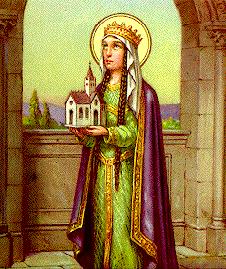
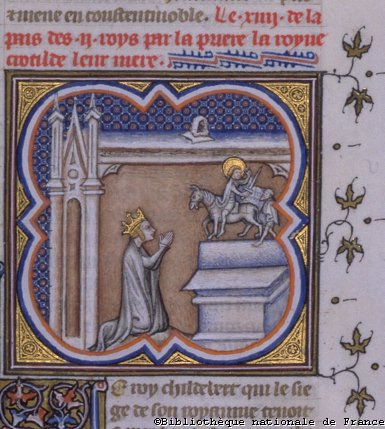
In art, Saint Clotilda is dressed in royal robes with an angel near her bearing a shield with fleur-de-lys (Roeder). She is often shown at the baptism of Clovis or as a suppliant at the shrine of Saint Martin. If you go through the images at Clothilde at Prayer, you will find most of her story in pictures. In Normandy, she was the patroness of the lame and invoked against death and iniquitous husbands (Farmer).


 Details of Clothilde's family with Clovis I (Clodovic)(Chlodwig) “The Great” de Meroving King of the Salian Franks
This page is within a frameset. View the entire genealogy report of , or surname index or report summary.
(GenoProReportIndividual)
Genogram Examples.
Copyright © 2011 GenoPro Inc. All rights reserved.