

 King Jorund Yngvasson of Uppsala




General Notes
Jorund or Eorund was a Swedish king of the House of Yngling. He was the son of Yngvi, and he had reclaimed the throne of Sweden for his dynasty from Haki (the brother of Hagbard, the hero of the legend of Hagbard and Signy).
When he was young he used to travel the seas and plunder with his brother Erik, and they were great warriors. One summer they plundered in Denmark where they met another pillager, King Gudlög of Hålogaland (a province in Norway) with whom they fought. They took him prisoner and carried him ashore at Stromones where they hanged him. Gudlaug's surviving companions raised a mound over him there.
Eyvind Skaldaspiller (a Norwegian):
By the fierce East-kings' cruel pride,
Gudlog must on the wild horse ride --
The wildest horse you e'er did see:
'Tis Sigur's steed -- the gallows tree.
At Stromones the tree did grow,
Where Gudlog's corpse waves on the bough.
A high stone stands on Stromo's heath,
To tell the gallant hero's death.[1] (http://www.sacred-texts.com/neu/heim/02ynglga.htm)
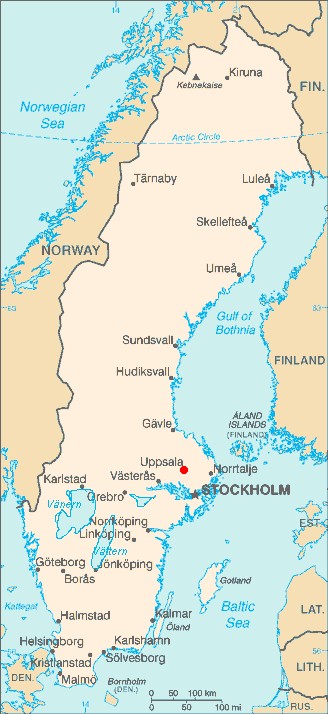
This act rendered the Swedish princes, Eric and Jorund, even more famous and they were thought of as even greater men. When they learnt that King Haki no longer had his forces around him, they decided to take care of their enemy. They assembled a large force that was joined by Swedes as they approached. They entered Mälaren (a bay at the time) and steered towards Uppsala. They left their ships at the Fyris Wolds and were met by Haki who had less men. Haki was a brutal fighter and managed to turn the tide of the battle. He slew Erik who held the banner and Jorund retreated with his men. Luckily, Haki had been seriously wounded and died.
Jorund then ruled Sweden at Uppsala, but he usually spent the summers pillaging. One summer, he plundered in Jutland and entered Limfjorden, where he continued the pillaging. They anchored in Oddesund (before a storm in 1825, it was near the innermost part of the fjord and almost 200 km from its mouth) but were discovered by the Norwegian pirate Gylaug of Hålogaland, the son of Gudlaug. Gylaug and his men attacked them and were joined by local forces who wanted revenge. As Jorund was vastly outnumbered (and had to run an almost 200 km long gauntlet to get out of the fjord), he lost the battle, and Gylaug had him hanged.
Jorund has travelled far and wide,
But the same horse he must bestride
On which he made brave Gudlog ride.
He too must for a necklace wear
Hagbert's fell noose in middle air.
The army leader thus must ride
On Horva's horse, at Lymfjord's side.[2] (http://www.sacred-texts.com/neu/heim/02ynglga.htm)
Primary sources
Ynglingatal
Ynglinga saga (part of the Heimskringla)
Historia Norwegiae
Secondary sources
Nerman, B. Det svenska rikets uppkomst. Stockholm, 1925.


 Details of Jorund's family
This page is within a frameset. View the entire genealogy report of , or surname index or report summary.
(GenoProReportIndividual)
Publish my family tree on the web.
Copyright © 2011 GenoPro Inc. All rights reserved.